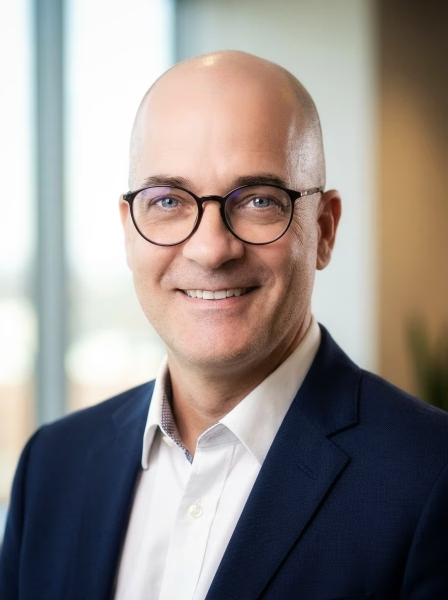
The practitioner.
Strategically structured, psychologically grounded — and drawn to work that is genuinely hard.
Eric Teunissen leads transformation programs as an interim executive, typically as Chief Operating Officer alongside the CEO. He has been working with organizations in transition since 1997 — across post-merger integrations, industrial relocations, and large-scale organizational redesigns — and he brings to that role a particular combination: the structural orientation of a program architect and the human sensitivity of a leader who has spent considerable time understanding what organizations are, not only what they produce.
ModelEric leads inside the client organization — at the table for critical decisions, responsible for outcomes. Not advisory. He approaches each engagement as both a design challenge and a human system. Transformation is not only operational — it is emotional and cognitive. The people being asked to change must be led through that change with clarity, coherence, and a shared understanding of where they are going. Eric builds that structure. He also builds the conditions in which capable people can find and sustain their best work.
His practice is grounded in three disciplines that operate simultaneously, under pressure, in real organizations with real constraints: aligning people with a compelling direction, fostering healthy and coherent organizational dynamics, and designing structured pathways through which change can actually move. The passion for that work is not incidental to the quality of the result — it is the source of it.
Division Group was founded on a single conviction: that transformation is fundamentally a design problem, and that leadership of real complexity requires the capacity to define new possibilities — not only to execute against existing ones. That conviction is the thread connecting the formation, the practice, and the professional code that follows.
Formation across three disciplines.
Not a résumé — a formation. Three streams of study that each make the others more precise. The combination is deliberate: the humanist tradition sharpens judgment; management science gives it structure; applied leadership brings both into the specific terrain of organizations under pressure. Each stream informs the others — and together they produce a practitioner who doesn't separate thinking from doing.
The study of justice, tragedy, literary form, music, and architecture — not as enrichment but as training in a particular capacity: to attend to what is actually in a situation, not just what is expected. Organizations are human institutions. That quality of attention doesn't come from management training — and the difference becomes visible under pressure.
The Certified Manager credential represents the formal, scientific counterpart to the humanist formation. Management is a discipline with its own body of knowledge — planning, organizing, leading, controlling — and the CM examination tests command of that body in full. The credential matters not as a title but as evidence of something specific: that the work of managing has been studied as seriously as the work of leading. The professional code of ethics that governs practice is set out in Section 03.
Strategy, organizational analysis, design thinking, and the psychology of leadership — studied at the level the senior executive role demands. This is the applied layer: the point where the humanist sensibility and the management framework meet the specific conditions of organizational life. The focus throughout was not general management but the senior executive role — what it demands, where it fails, and how it can be done with both rigor and humanity.
Books that have left a mark. Not an exhaustive list — a portrait of a particular way of reading, and thinking, about leadership and organizations.
The BookshelfThe code I operate by.
Seven principles. They govern how I work — with clients, with teams, and under pressure. Grounded in the ICPM Professional Code of Ethics; the articulation is mine.
Integrity
Integrity isn't a constraint on the work — it's the condition under which the work becomes possible. If a client relationship, a recommendation, or a business arrangement requires me to shade the truth, I decline it — before the conversation reaches that point.
Competence
I take mandates I'm equipped to execute. Knowing the limits of your competence is itself a form of competence — and overpromising what an engagement can deliver damages the organization, not just the relationship. The formation in Section 02 reflects a genuine commitment to continuous study, not credential collection.
Loyalty
My obligation, first and last, is to the organization and the people in it — not to the continuation of the mandate. If the honest answer is that the work is done, or that a different approach is needed, I say so.
Confidentiality
What I see inside an organization stays inside. Interim executives are trusted with the full picture — the tensions, the failures, the things that aren't written down. I don't trade in war stories, don't mine mandates for competitive intelligence, and don't use privileged access for anything other than the work.
Respect
Everyone in the organization gets the same quality of attention — from the board to the floor. Hierarchy is a tool for organizing decisions, not a measure of whose perspective matters.
Responsibility
I own what I call. When an assessment is wrong, a recommendation doesn't land, or a judgment proves flawed, the answer is to say so directly and correct course — not to reframe the history. Accountability is the mechanism by which trust is maintained over time, not a risk to be managed.
Concern for Society
Organizations exist within society, and the decisions made inside them reach further than the balance sheet. I won't take mandates that require me to act against the broader public interest — and I hold that the most durable organizations are those that take that obligation seriously, not as a brand position, but as a condition of legitimacy.
Grounded in the ICPM Professional Code of Ethics. Developed by the Institute of Certified Professional Managers' Board of Regents, USA.